 Cuepoint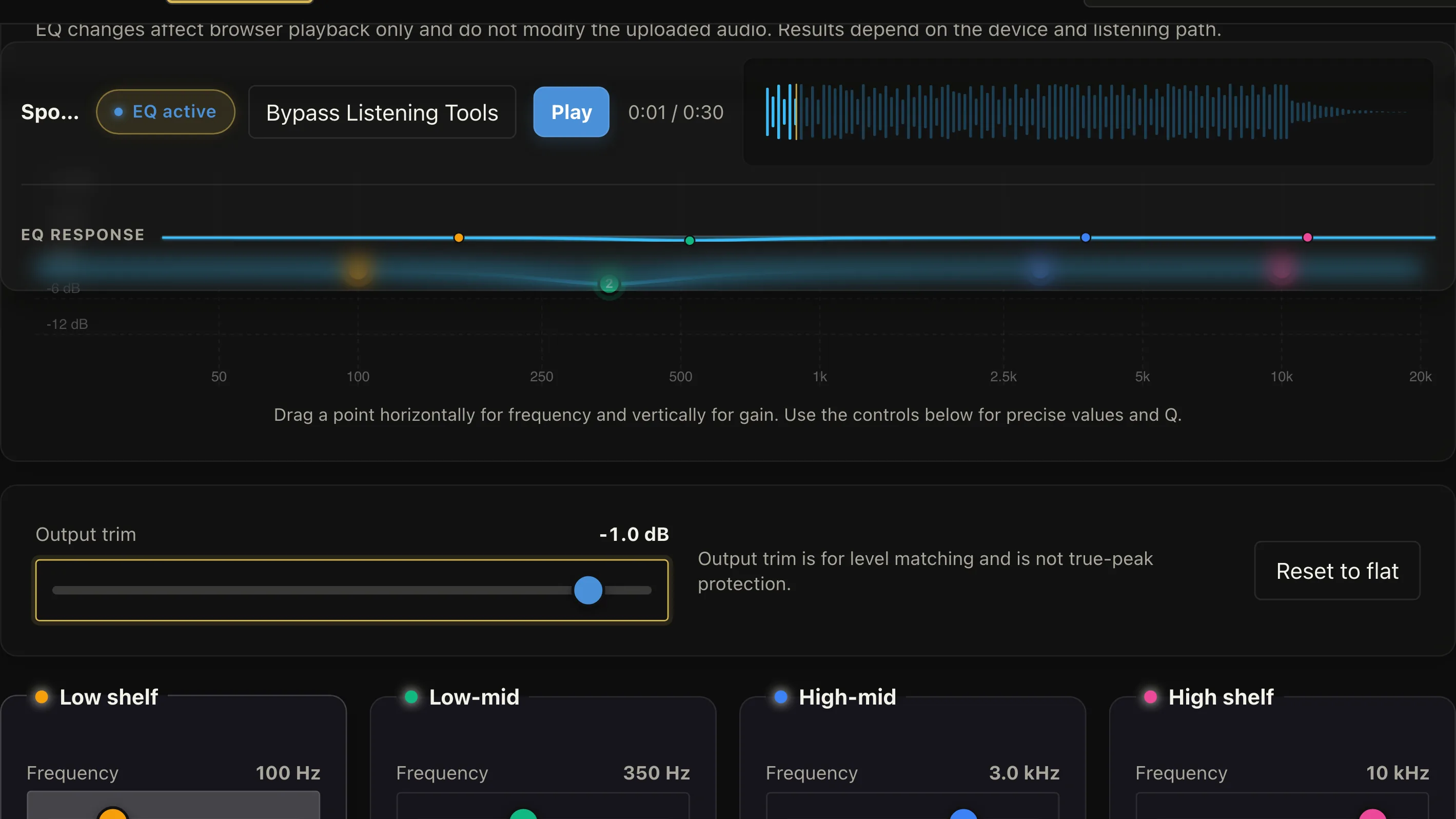
What loudness describes
Loudness is the perceived level of audio over time. Peak level tells you how close the highest sample or reconstructed peak comes to the ceiling, but it does not describe the complete listening experience. Integrated LUFS is one useful estimate of average perceived loudness across a whole program.
A louder version often feels more detailed, more energetic, and more finished during a quick comparison. That preference can appear even when the balances are otherwise unchanged.
What tonal balance describes
Tonal balance is the distribution of energy across the frequency spectrum. A mix can feel dark because high-frequency information is restrained, muddy because low-mid elements accumulate, thin because the lower range lacks support, or harsh because an upper-mid area dominates.
These descriptions are relationships, not universal targets. The appropriate balance depends on the arrangement, genre, performance, references, playback level, and creative intention.
Why louder can sound brighter
Human hearing does not respond equally to every frequency at every playback level. When the level rises, low and high frequencies may become more apparent relative to the midrange. A louder comparison can therefore feel both fuller and brighter even if no EQ changed.
The reverse also happens: adding upper-mid or high-frequency energy can make a mix feel more immediate, which listeners may describe as louder. That is why “make it louder” and “make it brighter” should not be treated as interchangeable instructions.
Ask the level question first
When comparing two revisions or a mix with a reference, reduce the obvious level difference before diagnosing tone. If the louder version still appears better after a reasonable match, listen for the specific reason: clearer vocal presence, firmer low end, wider ambience, or a different dynamic shape.
This order prevents an EQ decision from being used to solve what was mainly a playback-level difference.
Investigate a frequency area, not a magic curve
If the difference remains, describe the musical consequence. Does the bass hide the kick? Does the vocal become tiring on loud phrases? Do cymbals pull attention away from the chorus? Then preview a small, broad EQ change to test whether that area is related to the problem.
A diagnostic preview is not a recipe for the final mix. If reducing the low mids makes the lyric easier to hear, the cause might be one instrument, an arrangement overlap, dynamics, ambience, or the vocal itself. Return to the session and choose the musical solution.
Use measurements to focus your ears
Integrated loudness, true peak, loudness range, and spectral observations can make a question more precise. They cannot tell you whether the chorus is exciting, whether a vocal belongs in front, or whether the record communicates the intended emotion.
Cuepoint provides Technical Track Analysis plus track-level Listening Tools. Loudness profiles apply attenuation-only browser previews when integrated LUFS is available. A four-band diagnostic EQ and output trim help investigate frequency-balance questions. The original file remains unchanged, and the tools do not master or export processed audio.
Separate the questions before changing the mix.
Use Cuepoint to preview loudness and tonal-balance questions without touching the original audio.
Start free