 Cuepoint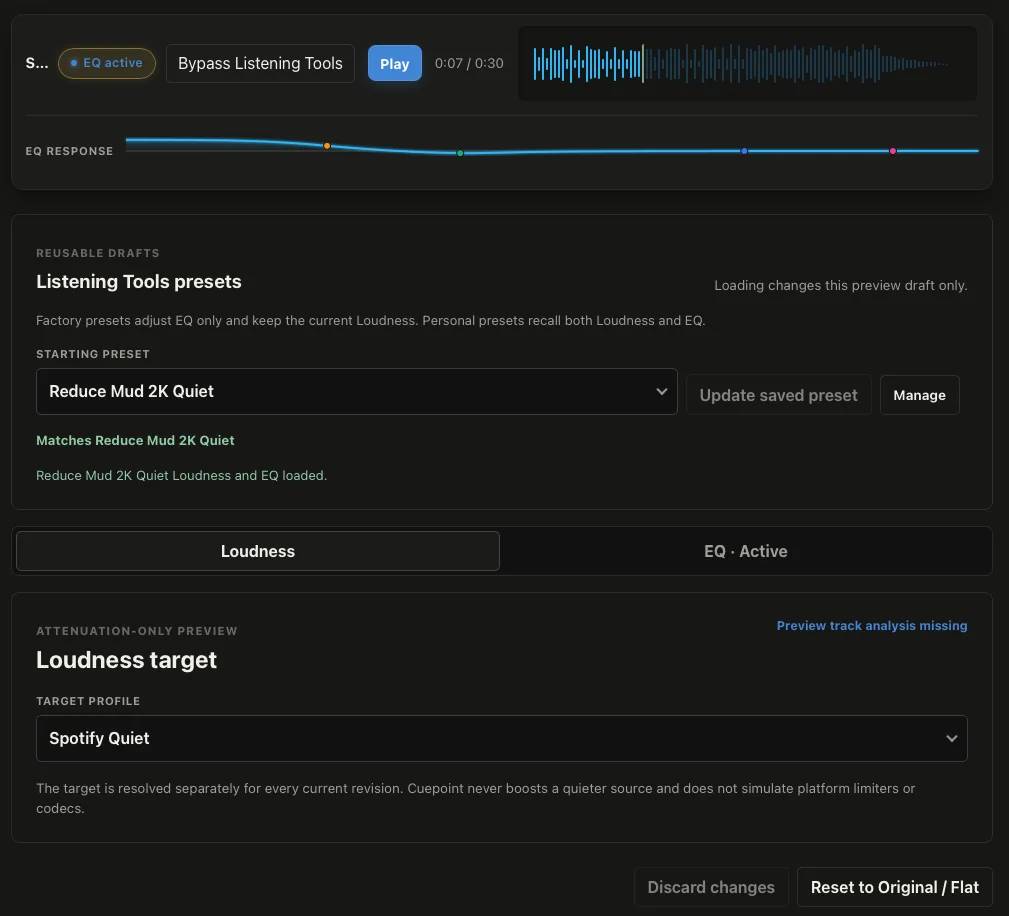
Begin with what was supposed to change
Before switching between versions, read the notes that led to the revision. If the request was to make the first chorus vocal easier to understand, that moment is the first test. An unrestricted comparison encourages listeners to discover new preferences before confirming whether the agreed problem was solved.
The question includes both the intended improvement and the musical tradeoff.
Match perceived level before judging
A slightly louder version often feels clearer, fuller, and more exciting even when the underlying balance is not better. Reduce that bias before deciding. Use a reliable level-matched comparison when available, or manually trim the louder version until both feel similar in overall level.
Do not treat a quick level match as mastering. It is simply a way to hear the tonal, spatial, and dynamic choices with less influence from loudness.
Compare short sections, then hear the full track
Looping a small section makes a targeted change easy to identify, but a mix is not a collection of isolated loops. After checking the exact moment, listen from before the transition and then play the track from beginning to end.
A vocal adjustment that fixes one crowded chorus may feel too forward in the sparse verse. A shorter delay may clean the bridge but remove the emotional lift into the final section. Local improvement and overall coherence must both survive.
Change one comparison question at a time
If you are evaluating vocal level, avoid simultaneously judging width, low end, and mastering level. Rapidly switching attention makes small differences feel more important than the musical result.
Work through the revision list in order. For each item, decide whether it is resolved, still open, or replaced by a more accurate description of the problem. This creates a useful record instead of a general preference contest.
Watch for regressions without reopening everything
A regression is a new problem caused by the revision: the vocal is clearer, but its sibilance now dominates; the kick has more definition, but the low end loses weight. Record that consequence beside the relevant change.
A new creative idea is different. It may be worth exploring, but it should not be presented as proof that the previous request failed. Naming the difference protects the review from endless scope expansion.
Document the decision in plain language
After comparing, write a conclusion that another person can understand later:
“Mix 03 solves the chorus-vocal note. Keep the new automation. The bridge delay is cleaner, but restore a little of the final repeat before the guitar entrance.”
This is more useful than “03 is better.” It tells the producer what stays and what remains to change.
Keep versions and feedback together
A fair comparison is difficult when one version is in email, another is in a transfer folder, and the reason for the change is in chat. Keep the current revision, earlier audio, and the original comment in one review history.
Cuepoint Pro stores revisions under one track identity. Timestamped threads preserve the questions that led to the new version, while Listening Tools can provide a non-destructive loudness preview when technical analysis is available. The tools help focus the comparison; your ears still make the decision.
Compare the answer, not just the files.
Keep revision history and the listening question together in Cuepoint.
Start free