 Cuepoint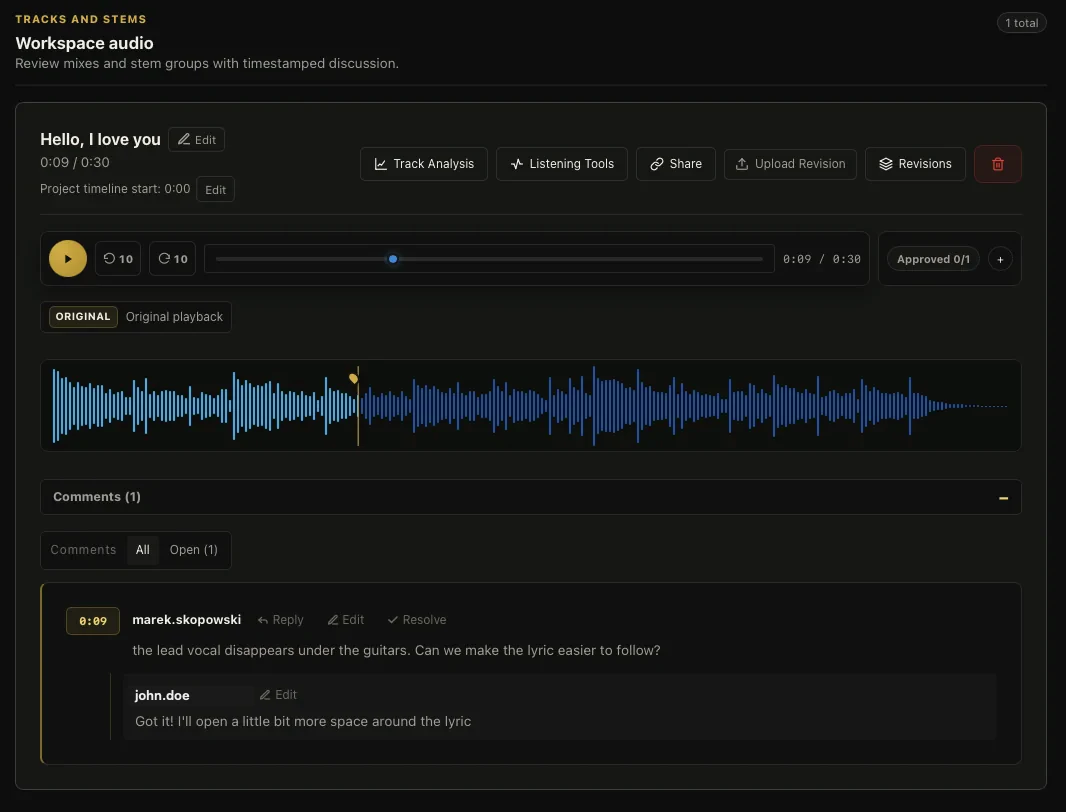
Start with the listening question
Before writing a note, decide what you are evaluating. Are you listening for vocal clarity, the energy of the chorus, the relationship between kick and bass, or whether the ending feels complete? A focused question keeps you from reacting to every detail at once.
It also gives the producer useful context. “The chorus is not working” leaves the problem open. “The chorus feels smaller than the verse” identifies a contrast that can be investigated.
1. Name the exact musical moment
Begin with a timestamp and a recognizable event: the first word of verse two, the snare fill before the chorus, or the final note of the guitar solo. A timestamp removes the first round of clarification, while the musical description confirms that everyone is hearing the same place.
2. Describe what you hear
Write the audible observation before proposing a fix. Useful words describe relationships: louder, softer, wider, narrower, brighter, darker, closer, farther away, masked, sharp, muddy, or unstable. Avoid describing the person who made the mix. The note is about the sound.
“The vocal disappears under the guitars” gives the mixer several possible routes. “Add 3 dB at 4 kHz” assumes the cause and may create a different problem. If you know the exact technical change is required, say so—but do not make a technical prescription your default language.
3. Explain the result you want
A clear intention helps the producer choose the right move. You might want the lyric to be easier to follow, the drop to feel more dramatic, or the backing vocal to support rather than compete with the lead. This communicates priority without taking creative judgment away.
“2:14 — the lead vocal disappears under the guitars. Can we make the lyric easier to follow?”
That note contains a location, an observation, and an intended outcome. It is brief, but it gives the producer enough information to start.
Separate reactions from solutions
Reactions are valuable. “I stop believing the chorus here” or “the ending feels abrupt” may be exactly what the artist needs to communicate. Label the reaction honestly rather than disguising it as an engineering instruction.
If you have a possible solution, present it as an option: “Could a longer reverb tail help the transition feel less abrupt?” This keeps the discussion collaborative and leaves room for a better answer.
Keep one decision in each note
A long paragraph attached to one timestamp often contains several unrelated requests. Split them. One note about the vocal level, another about the reverb tail, and another about the drum fill are easier to answer, revise, and resolve.
Before sending feedback, remove duplicates and separate preferences from blockers. Mark what must change before approval and what is simply worth trying. A producer can then prioritize the revision instead of guessing which sentence matters most.
A simple mix-feedback template
Use this structure whenever a note feels vague:
- Where: timestamp plus the musical event.
- What: the audible issue or reaction.
- Why: the result you want for the listener.
In Cuepoint, a comment is attached directly to the waveform, so the location travels with the note. Replies and later revisions stay in the same project context instead of becoming a separate message thread.
Put the note beside the music.
Start a Cuepoint project and turn the next listening reaction into feedback everyone can act on.
Start free